 The Bangladesh Travel Guide
Travel Bangladesh : Sundarban and Khulna Division
:: Mongla
Being the second largest sea port of Bangladesh it plays a pivotal role for our country’s economy.There are a good number of prawn hatcheries in Mongla. The place is situated in the Mongla sub-district of Bagerhat district. It is in fact the busiest area of the whole Khulna decision. Being the most active seaport of Bangladesh it is open 24/7. The travelers can drop by any time and take a look at the most humongous ships of Bangladesh with cargo. After the Chattogram seaport, this is the busiest seaport of Bangladesh.
:: Shat Gambuj Mosque
In mid-15th century, a Muslim colony was founded in the inhospitable mangrove forest of the Sundarbans near the seacoast in the Bagerhat district by an obscure saint-General, named Ulugh Khan Jahan. He was the earliest torch bearer of Islam in the South who laid the nucleus of an affluent city during the reign of Sultan Nasiruddin Mahmud Shah (1442-59), then known as 'Khalifalabad' (present Bagerhat). Khan Jahan aborned his city with numerous mosques, tanks, roads and other public buildings, the spectacular ruins of which are focused around the most imposing and largest multidomed mosques in Bangladesh, known as the Shait-Gumbad Masjid (160'X108'). The stately fabric of the monument, serene and imposing, stands on the eastern bank of an unusually vast sweet-water tank, clustered around by the heavy foliage of a low-laying countryside, characteristic of a sea-coast landscape. So in the year 1459 the great Azam Ulugh Khan Jahan established this mosque, which called Shat Gambuj Mosjid. In Bengali Shat means the number 60. Though it is called Shat Gambuj Mosjid, actually the numbers of Gamboj in the mosque are 81. The mosque roofed over with 77 squat domes, including 7 chauchala or four-sided pitched Bengali domes in the middle row. The vast prayer hall, although provided with 11 arched doorways on east and 7 each on north and south for ventilation and light, presents a dark and somber appearance inside.
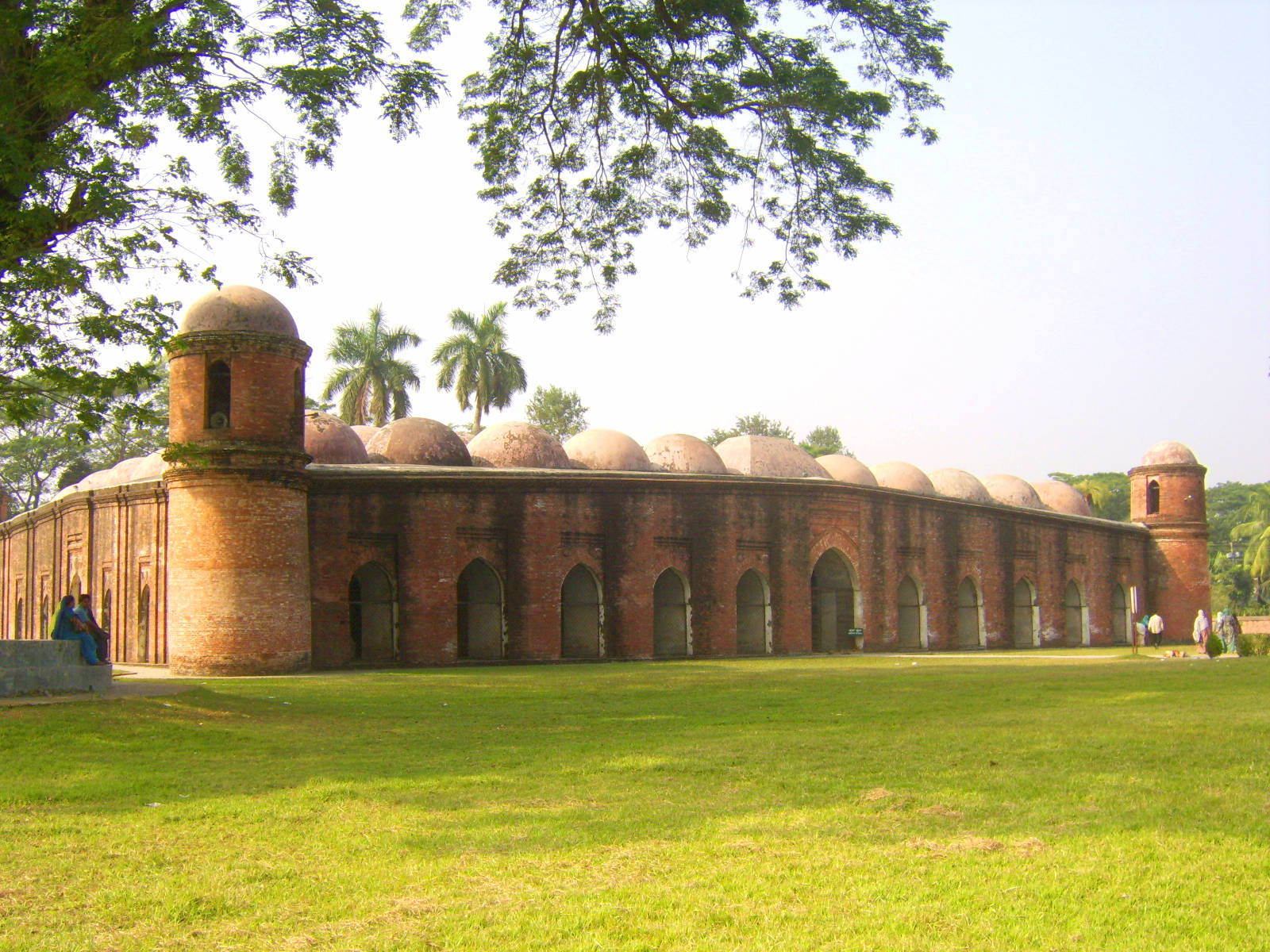 [Shat Gombuj Mosque - Bagerhat]
It is divided into 7 longitudinal aisles and 11 deep bays by a forest of slender stone columns, from which springs rows of endless arches, supporting the domes. Six feet thick, slightly tapering walls and hollow and round, almost detached corner towers, resembling the bastions of fortress, each capped by small rounded cupolas, recall the Tughlaq architecture of Delhi.
The general appearance of this noble monument with its stark simplicity but massive character reflects the strength and simplicity of the builder. This mosque is 160 ft long and 108 ft. in its width. This is one of the most beautiful archeological and historical Mosque in Bangladesh made by red burn mud.
The archeological beauty of this Mosque enchants the tourist till now. Besides this Mosque an archeological museum is there where you can find that times archeological and historical materials.
:: Shrine of Hajrat Khan Jahan Ali
Besides the Shat Gambuj Mosque, shrine of Hajrat Khan Jahan Ali is only 3 km ahead. You can go there by rickshaw (a three wheeled peddler). A great number of tourist goes the shrine to pray for this great man Hajrat Khan Jahan Ali. From this shrine a steamer goes to the Thakur Dighi where you will find the ancient crocodiles in this Dighi. (Dighi is a local name of larger pond) Besides this Dighi a Nine Gambuj Mosque is an attraction also for the tourists.
:: Shagordari (Jessore)
This is another tourist spot, which is in Jessore district, under Khulna Division. Sagordari is famous for the residence of Great poet Michael Modhusudon Datta, famous for his wonderful composition of sonnets. He was born in the year 1824 and died in 1873. This two-storied residence, which is known as Michel Modhusudon museum, is now under the custody of Bangladesh Archeological Department, where you can see the daily usage materials of the great poet. Every year from 25-30 January a great mela (exhibition) is organized here, which is called Modhumela need after our beloved poet. A huge crowd comes to Shagordari every year for the occasion of this mela.
:: Shilaidaha Thakur Bari (Kustia)
Shilaidaha Thakur Bari was made by the forth father-in-law Prince Darkanath Tagore of great poet Robindranath Tagore. Now it is a museum where you can see the daily usage materials of Tagore family.
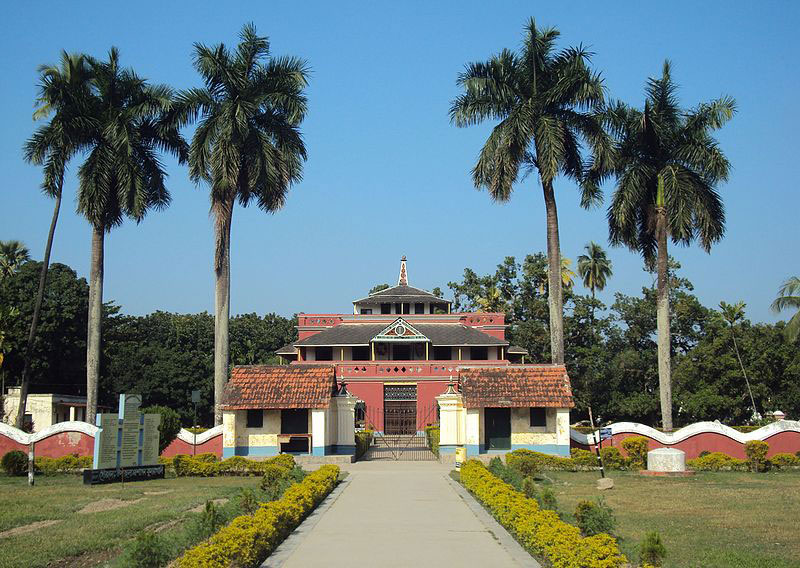
In Kustia you also can visit the Shrine of Lalan Shah, the great folk singer of Bangladesh. His folk songs are popularly known as Lalan Giti. You can also visit to the Mujib Nagar. Mujib Nagar Smriti Shoudh is built by 23 Stambha at 20 acrs areas of land. At the time of liberation war in 1971 Mujib Nagar was the temporary capital of Bangladesh.